
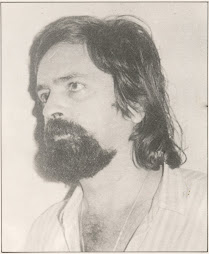
"In the field of poetry, great differences between white and black audiences can be perceived। The white one remains silent whereas the black one participates nearly as much as in a concert। Sitting down quietly is a good-mannered cultural behaviour. And good manners dispel creativity. We come from an expressive culture. The performer (poets, musicians, actors, sportsmen) is fed by the audience. When the audience expresses something the performer is filled with energy and gets better and better. African culture and therefore Afroamerican culture has always been proactive".
QUINCY TROUPE
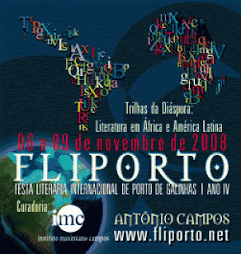
FLIPORTO 2008 : THE PATH OF THE AFRICAN DIASPORA
We are crossing the Atlantic ocean, but in the inverse direction took by the slave ships that brought more than 9 million slaves to our continent since the first years of the 16th century. In the 120th anniversary of the abolition of slavery in Brazil, the International Literature Congress of Porto de Galinhas (FLIPORTO) will pay tribute to the importance of Africa to Brazil and Latin America.
We, Afro-Brazilians, Afro-Latin Americans, confront the codes of discrimination and oppression. Returning to the place of origin of our people is not merely a geographical event, as Africa resides solid in our ethnical memory. This tribute is about meeting once again with our psychological ground, our clearer view, the physiognomy that was not made invisible.
We, Latin Americans, will congregate the various ramifications of the African Diaspora in the post-colonial time. We, conscious of our origins, know that the Iberian colonizers themselves brought with them North-African blood due to the eight centuries in which they dominated the peninsula.
We have had in Brazil for last five years a law (nr 10.639), which was approved in January 9th 2003, that makes the teaching of African culture and history compulsory in middle and high school, establishing directives to the inter-ethnical relations in our country.
Multicultural education signifies the recovery of historical and social plenitude in relation to racial identity, and to the diversity of our multi-ethnical society, implementing actions that overcome the historical falsification of our African descendants.
In Brazilian universities, there has been is a boom of academic studies about African authors, and about the formation of the continent and its evolution from the Egyptian culture to the more recent political events. The reason behind this increased interest in Africa is the study of African historiography, of its identity traces in significant happenings, and the preoccupation with common problems, such as deforestation and poverty.
In 1925, the Mexican José Vasconcelos stated that a new race was appearing in Latin America, a race made by the richness of all of the previous races - a final race, a cosmic race. There is a series of philosophers like José Vasconcelos that have helped our people to maintain our self-esteem, such as Bartolomá de Las Casas (America’s apostle), Simon Bolívar, José Marti, Sousândrade, and José Veríssimo. In addition, we recognize the importance of Aztecan mythology, as beautiful as Greek mythology; we experience the richness of our mixed society, and feel proud of the African presence in our culture, music, temper, and literature.
The third FLIPORTO, which took place in September, last year, was also an international event, and Brazil was made the congregation spot of various Latin American countries. Cuba, Colombia, Nicaragua, Puerto Rico, Dominican Republic, Bolivia, Chile, Peru, Mexico, Argentina, Uruguay, and Venezuela were represented in the event by notable writers of each country. Additionally, the event took place in a very relaxed environment, characteristic of the northeast of Brazil. Important authors from the state of Pernambuco and other Brazilian states were also present in the event, and our guests were impressed with the large audience that attended the congress, euphoria that is compatible with the intensity and professionalism in which we developed our project.
Now we have extended our project to Africa and, in 2008, FLIPORTO’s theme is The Path of the African Diaspora: Literature in Africa and Latin America. We will concentrate mainly in the countries of Portuguese language; however, we will pay tribute to authors such as the first black African female to receive the Nobel Price of Peace, Wangari Maathai (Kenya, 2004), and the first black African to receive the Nobel Price of Literature, Wole Soyinka (Nigeria, 1986).
We will also pay tribute to the Afro-Brazilian poet Cruz e Sousa, founder of the symbolism in Brazil, in the 110th anniversary of this death, as well as the poet Castro Alves, for the 140 years of public presentation of his poem Tragédia no Mar (Tragedy in the Ocean, 1868), also known as Navio Negreiro (The Slave Ship).
In addition, we will pay tribute to another Brazilian writer - Jorge Amado, for the 70 years of publication of the book Juiabá in France. The book began being published in France after the editions of the books O País do Carnaval (The Country of Carnival), Suor (Sweat), Cacau, Mar Morte (Death Ocean), Capitães de Areia (Sand Captains), and Jubiabá itself, were burnt as ordered by the Sixth Military Region.
FLIPORTO 2008 will also pay tribute to the centenary of the Afro-Brazilian poet Solano Trindade, born in Pernambuco, as well as Josué de Castro, celebrating 100 years of his birth, and, finally, we will pay tribute to the 120 th anniversary of the abolition of slavery in Brazil.
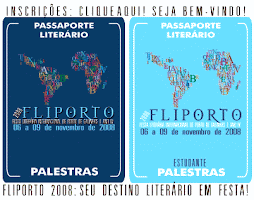
In the beach of Porto de Galinhas, which is an old slavery port, from the 6th to the 9th of November 2008, there will be a congregation of ethnicities: writers from Angola, Mozambique, Cabo Verde, Guinea Bissau, Sao Tome and Principe, will debate themes of common interest with Brazilian and Hispanic-American writers, Portuguese and Spanish authors interested in post-colonialism, as well as important contemporary theorists in the field of inter-ethnical and cultural studies.
Everything will be put in a perspective that does not perceive literature as mere entertainment, but as an educational factor of humanistic configuration, as part of culture, as an ethnic/aesthetic principle to fill the void and to strengthen in mankind the courage, the resistance, the taste of beauty, the search for oneself, and the solidarity among people.
Tradução ao Inglês : MARINA MARTENSSON
TRILHAS DA DIÁSPORA : LITERATURA EM ÁFRICA E AMÉRICA LATINA
Atravessar o Atlântico , mas no sentido inverso ao dos navios negreiros que trouxeram ao nosso continente mais de 9 milhões de escravos, a partir dos primeiros anos do século XVI. Aos 120 anos da Abolição, Celebrar o significado da África no Brasil e na América Latina, nós, afro-brasileiros, afro-latinos., no confronto aos códigos de discriminação e opressão. Não é geográfico esse ponto de retorno, uma vez que reside inquebrantável dentro de nossa memória étnica. Trata-se de um reencontro com o nosso chão psicológico, nossa paisagem mais nítida, a fisionomia que não conseguiram tornar invisível.
Latino-americanos a congregar os vários desdobramentos da diáspora africana nestes tempos pós-coloniais. Conscientes de suas vastas raízes, sabedores que os próprios iberos colonizadores já traziam dentro de si o sangue norte-africano, após 8 séculos em que eles dominaram a península.
Brasileiros que há cinco anos tem em sua legislação a de número 10.639, sancionada a 9 de janeiro de 2003, tornando obrigatório, no ensino Fundamental e Médio, o ensino de história e cultura afro-brasileira e história e cultura africana, estabelecendo diretrizes para as relações inter-étnicas em nosso país.
A educação multicultural vem significar o resgate da plenitude histórica e social quanto à identidade racial e à diversidade na sociedade pluriétnica ,.implementando ações que superem a falsificação histórica aos afro-descendentes. Há nas universidades brasileiras um verdadeiro boom de estudos acadêmicos sobre autores africanos, sobre a formação do continente e sua evolução desde mesmo a cultura egípcia até os processos políticos mais recentes. O caminho seguido é a releitura da historiografia africana, o percurso de seus traços identitários em fatos marcantes, a preocupação com problemas comuns , como o desmatamento e a pobreza
Em 1925, o mexicano José Vasconcelos afirmou que na América Latina estava se formando uma nova raça, feita com a riqueza de todas as anteriores, a raça final, a raça cósmica. Há uma seqüência de pensadores que tem ajudado o nosso povo a não perder jamais a auto-estima, desde Bartolomá de Las Casas, o Apóstolo da América, até Simon Bolívar, José Marti, ,Sousândrade, José Veríssimo. Sabemos reconhecer a importância da mitologia azteca, bela como a da Grécia, sentimos a riqueza da nossa cultura mestiça, sentimos orgulho da presença africana em nossa cultura , na música, no temperamento,ç na literatura.
A terceira versão da FLIPORTO, realizada em setembro do ano passado, internacionalizou-se e transformou o Brasil em um pólo congregador dos vários países latino-americanos. Cuba, Colômbia, Nicarágua, Porto Rico, República Dominicana, Bolívia, Chile, Peru, México, Argentina, Uruguai,Venezuela estiveram aqui representados, escritores referenciais em suas comunidades, com militância ativa em seu pacto literário. E tudo em um ambiente descontraído, característico do Nordeste , presentes também grandes nomes nacionais e pernambucanos, de modo que os convidados ficaram impressionados inclusive com o grande público presente à programação literária, em uma euforia compatível com a intensidade e profissionalismo como foi desenvolvido o nosso trabalho.
Agora, nos estendemos à África. Mais detalhadamente aos países de língua portuguesa, porém celebrando autores como a primeira mulher africana negra a receber o Prêmio Nobel da Paz, Wangari Maathai (Quênia, 2004) e o primeiro africano negro Prêmio Nobel de Literatura, Wole Soyinka(Nigéria,1986). Homenageando o poeta negro Cruz e Sousa, fundador do nosso simbolismo, aos 110 anos de sua passagem, bem como ao poeta baiano Castro Alves, pelos 140 anos da apresentação pública de Tragédia no Mar, que viria a se chamar O Navio Negreiro (1868). Homenageamos nesta versão o grande escritor Jorge Amado, pelos 70 anos de publicação na França de Jubiabá, vitória obtida após haverem sido queimadas, no ano anterior, as edições de O país do carnaval, Suor, Cacau, Mar Morte, Capitães de Areia e o próprio Jubiabá, por determinação da Sexta Região Militar. A FLIPORTO 2008 presta , ainda, uma significativa homenagem ao centenário do poeta negro pernambucano Solano Trindade, bem como aos 120 anos da Abolição.
Na praia de Porto de Galinhas, antigo porto de escravos, dar-se-á o encontro/reencontro das etnias: escritores de Angola, Moçambique, Cabo Verde, Guiné Bissau, São Tomé e Príncipe, debatendo temas de interesse comum com escritores brasileiros, hispano-americanos, autores portugueses e espanhóis entusiasmados com o pós-colonialismo, teóricos fundamentais contemporâneos dos estudos inter-étnicos e culturais. Tudo dentro da perspectiva que não vê a literatura como mero entretenimento, mas como fator educacional de formação humanística, como parte da cultura, como princípio ético/estético a preencher o vazio e fortalecer no homem a coragem, a resistência, o gosto da beleza, a busca de si mesmo, a solidariedade entre os povos. ANTONIO CAMPOS (CURADOR GERAL DA FLIPORTO)
[















Nenhum comentário:
Postar um comentário